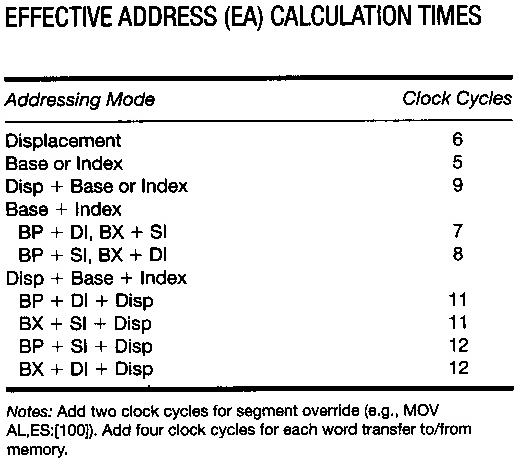
Effective address calculation times:
| <<< Relation of Base Registers to Memory Segments | Index | >>> |
Immediate Mode (memory is not accessed) - operand is part of the instruction. For example, a constant encoded in the instruction:
            mov eax,567
            mov ah, 09h
            mov dx, offset Prompt
Register Addressing (memory is not accessed) - operand contained in register:
add ax, bx
Direct Mode (memory accessed once) - operand field of instruction contains address of the operand:
      value dword 0
            ..
            add eax, value        ; Either notation does the
            add eax, [value]      ; same thing
Assembly code
        tbl DW 20 DUP (0)
            ..
            mov [tbl], 56
is equivalent to C statement
tbl[ 0 ] = 56; // C code
register indirect addressing (aka indirect addressing mode) often used for addressing data arrays inside programming loops:
Effective address of operand contained in a register.
For 32-bit addressing, all 32-bit registers can be used.
For 16-bit addressing, the offset value can be in one of the three registers: BX, SI, or DI:
            mov bx, offset Table  ; Load address
            add ax, [bx]          ; Register indirect addressing
Square brackets [ BX ] indicate that BX is holding a memory offset.
Operand [ BX ] serves as a pointer to data in memory.
Register indirect can be used to implement arrays. For example, to sum an array of word-length integers,
            mov cx, size          ; set up size of Table
            mov bx, offset Table  ; BX <- address of Table
            xor ax, ax            ; zero out Sum
     Loop1:
            add ax, [bx]
            inc bx      ; each word is 2 bytes long, so
            inc bx      ; need to increment BX twice!
            loop Loop1
Indexing: constant base + register.
Fixed Base (address) + Variable Register Offset (operand field contains a constant base)
Effective address is obtained by adding value of operand field to contents of register.
This is known as array type addressing, also called displacement addressing.
            mov eax, [ ebx + 5 ]
            mov eax, [ ebx + esi + 5 ]
There are restrictions on the combinations of registers allowed within the brackets: you can have ESI or EDI, but not both, and you can have EBX or EBP, but not both.
The following instructions are equivalent:
            add ax, Table[ bx ]
            add ax, [ Table + bx ]
            add ax, Table + [ bx ]
            add ax, [ bx ] + Table
Indexing With Scaling: Base + Register Offset * Scaling Factor
Operand field contains base address.
Useful for array calculations where size of component is multiple bytes long.
Stack Addressing: PUSH and POP, a variant of register indirect with auto-increment/decrement using the ESP register implicitly.
Jump relative addressing, EIP + offset
Operand field contains a displacement.
Used by near and short jump instructions on the Intel 80x86. see also:
Effective address calculation times:
| <<< Relation of Base Registers to Memory Segments | Index | >>> |