CIS-255 Home
http://www.c-jump.com/bcc/c255c/c255syllabus.htm
C++ Exceptions
- Exceptions
- Error detection and handling considerations
- Exception mechanism
- What is an exception ?
- Example of throwing exception
- Throwing exceptions with info
- Catching exceptions
- throw syntax and semantics
- try-catch syntax and rules
Exceptions
-
Problem: dealing with errors is a pain, even in a simple language like C.
-
It's even worse in C++, where some obvious approaches don't work.
-
Exceptions provide a new mechanism for dealing with errors.
-
Fundamentally exception a control construct.
Error detection and handling considerations
-
A function which detects an error might be able to deal with it, or might not.
-
If not, it should notify someone who can. Obvious candidates are callers of the
function.
-
How do we notify callers of an error ?
-
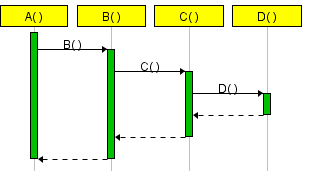
If A calls B calls C calls D and only A can deal with the error detected by D, can
we avoid involving B and C in the communication ?
-
What form should the communication take ?
|
|
Exception mechanism
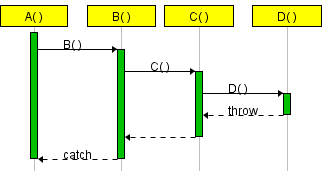
A function which detects an error can throw an exception. A function which can deal with errors can catch
an exception. When an exception is thrown, control "travels" up the call stack, "looking" for a function that can catch it. If none is found, some default behavior is invoked (typically termination).
|
|
What is an exception ?
-
An object of any copy-able type can be an exception:
    #include <iostream>
    void main() {
        try {
            throw 20;
        }
        catch ( int ex ) {
            std::cout << "Exception occurred: " << ex;
        }
    }
-
Avoid using native types: int,
bool, and so on.
-
Often classes are created specifically for exceptions.
-
The STL provides several exception types.
Example of throwing exception
// account.h
// A banking account:
class Account { /*...*/ };

// An exception class:
struct AcctError {};
|
// main.cpp
#include <iostream>
void main() {
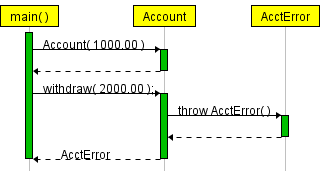
    Account acct( 1000.00 );
    try {
        acct.withdraw( 2000.00 );
    }
    catch ( AcctError& ex ) {
        std::cout << "Not enough funds";
    }
}
|
// account.cpp
void Account::withdraw( double amount )
{
    if ( amount > m_available_balance ) {
        // Not enough balance,
        // Unnamed temporary object:
        throw AcctError();
    }
    // Balance is ok, proceed...
}
|
Throwing exceptions with info
    struct AcctError
    {
        std::string problem;
        AcctError( std::string str )
        {
            problem = str;
        }
    };

    void Account::withdraw( double amount )
    {
        if ( amount > m_available_balance )
        {
            throw AcctError( "Insufficient funds." );
        }
        //...
    }
Catching exceptions
    #include <iostream>
    #include "account.h"
    int main()
    {
        Account acct;
        acct.deposit( 100.00 );

        try {
            acct.withdraw( 1000000.00 );
        }

        catch ( AcctError& e ) {
            std::cout << "Error: " << e.problem << endl;
            return 1;
        }

        return 0;
    }
throw syntax and semantics
-
A throw statement is syntactically like a return statement.
-
Execution immediately leaves the function that throws.
-
Local objects are all normally destroyed (like a return).
-
Stack is unwound, thus destroying local objects in each stack frame until
catch
is found.
-
Execution resumes with first catch statement.
-
When catch finished, execution continues with statements after catch.
try-catch syntax and rules
-
A try block must use braces {} and has its own scope.
-
A try block must be followed by one or more catch blocks.
-
A catch block must use braces {} and is a scope.
-
Each catch block must have a declaration list
-
Declaration lists declare one type, with an optional identifier.
-
The catch block can treat the identifier like a local variable.
|
-
catch block identifiers shadow other local variables.
-
It is possible to catch *any* exception:
void f()
{
    try
    {
        acct.withdraw( 2000000 );
    }
    catch ( ... )
    {
        // free dynamic memory:
        delete[] my_temp_array;
        throw;
    }
}
|